


 Metropolitan France
 United Kingdom
 Deutschland
 Belgique
 Suisse
 Österreich
 España
 Italia
 Danmark
 Sverige
 Portugal
 Polska
 Luxembourg
 Other countries



Available colours:
Available colours:

Available colours:


Available colours:

Available colours:


Available colours:
Available colours:
Available colours:

20% off
On the entire city section* with the code CITY20*

Available colours:

Available colours:


Available colours:


Available colours:

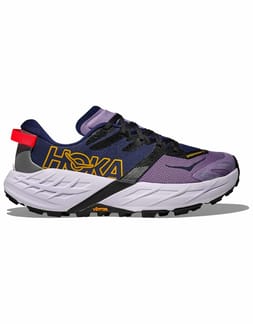
Available colours:


Available colours:

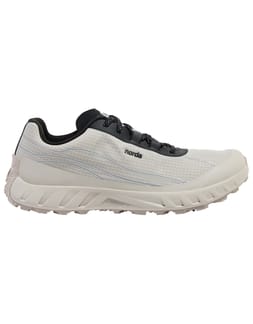
Available colours:


Available colours:

Available colours:



FALL SALE: UP TO 50% OFF
On a wide selection of products*

Available colours:

Available colours:

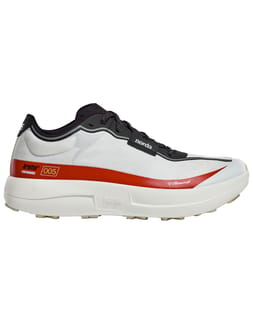
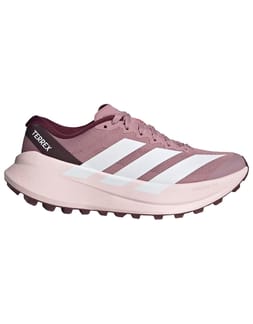
Finding the right trail running shoe means protecting your feet, knees and joints, whatever the terrain. Snowleader offers a wide selection of men's trail running shoes and women's trail running shoes from the most renowned trail running brands, supporting you from forest paths to high mountain races.
Why choose the right trail running shoes?
On rocky paths or muddy single tracks after rain, a standard running shoe quickly shows its limits. The trail running shoe is designed for these conditions: deeper lugs, lateral reinforcements, toe bumpers and a midsole engineered to absorb repeated shocks on uneven ground. While a road running shoe focuses on performance on tarmac, the trail running shoe provides the grip, stability and protection you need to run off-road without fear of slipping or injury. You can also find our selection of the best men's trail running shoes on the Snowleader blog.
Key features of trail running shoes
Before making your choice, a few technical criteria deserve your attention. They directly affect the comfort and safety of your trail running outings:
- Grip (lugs): the outsole must offer optimal traction on varied surfaces. Deep lugs (5 mm and above) are ideal for soft and muddy ground, while shorter, closer lugs work better on dry, compact terrain. For enhanced stability, choosing a Vibram sole can be particularly relevant.
- Drop: the difference in height between the heel and forefoot. A lower drop gives a more natural stride. A high drop (8 to 12 mm) provides more cushioning under the heel and suits heel strikers, while a low drop (0 to 6 mm) encourages a more dynamic midfoot strike.
- Cushioning: protects your joints and arch from repeated impacts, especially on hard ground and technical descents.
- Weight: the weight of the shoe is also important, especially if you are looking for performance. Expect between 250 g and 350 g for a competition-oriented model, and up to 400 g for a shoe prioritising protection over long distances.
- Protection: a toe bumper and lateral reinforcements protect your foot from impacts on rocky trails.
These guidelines will help you refine your search, whether you are new to the trails or preparing for a demanding race. Snowleader also offers a range of women's trail running shoes designed for performance, with fits adapted to female morphology.
The best trail running shoe brands
Salomon remains a benchmark for trail running in France, especially with versatile models like the Sense Ride, equally at home on forest paths or technical mountain routes. For runners seeking generous cushioning over ultra distances, Hoka One One trail running shoes stand out with their oversized soles, designed to absorb shock mile after mile.
La Sportiva brings mountain expertise from its alpine heritage, with shoes built for steep terrain and significant elevation. The market also features innovative brands: On Running trail running shoes focus on lightness and unique cushioning systems, while Scott offers responsive models, particularly appreciated in competition.
How to choose your trail running shoes?
Choosing according to terrain
The terrain dictates the type of trail running shoe you need. There are three main categories:
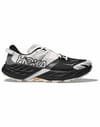
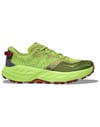
- Mountain trail: you need soles with excellent grip and thick protection to cushion impacts. The SpeedGoat from Hoka One One meets these requirements perfectly.
- Mixed trails: between forest tracks and rolling sections, choose a versatile shoe with a good balance of grip and comfort. A model with medium lugs and moderate cushioning will cover most of your runs.
- Urban trail: on hard surfaces, cushioning is key. Opt for a shoe with a thick midsole and shallow lugs, which will absorb impacts while remaining comfortable on tarmac and stabilised paths.
Beyond the type of terrain, remember that conditions can change during a single run: a trail starting on a wide forest track can quickly turn into a narrow, technical and exposed path. If your routes vary regularly, a versatile model with multidirectional lugs will be your best ally, able to adapt to most surfaces you encounter.
Choosing according to distance
Your usual mileage will guide you towards a specific shoe profile:
- Short distances (less than 20 km): a light and responsive trail running shoe will help you maintain a dynamic stride without sacrificing grip.
- Medium distances (20 to 50 km): the balance between cushioning and lightness becomes crucial. A model with good support and sufficient cushioning will help prevent premature muscle fatigue.
- Ultra trail (over 50 km): comfort and protection become priorities. Choose generous cushioning and a moderate drop (4 to 8 mm) to relieve your joints over long distances.
For more detailed advice, see our guide to choosing trail running shoes.
Choosing according to foot shape
Foot shape varies greatly from one runner to another, and it is a criterion often overlooked. Forefoot width, arch height, overall volume: these factors directly affect the fit and comfort of your trail running shoe. Men's and women's trail running shoes differ in shape and size to suit every morphology. If you have wide feet, look for models with a generous fit; conversely, a narrow foot will find better support in a shoe with a snug volume.
Innovative technologies in trail running shoes
Waterproof and breathable membranes
When the weather turns in the mountains or you run through morning dew, a waterproof membrane makes all the difference. Gore-Tex (GTX) technology remains the benchmark: it keeps water out while allowing sweat to escape, preventing the "wet foot" effect from both rain and perspiration. You will find Gore-Tex models from Altra, Salomon, La Sportiva and Saucony.
For trail running in wet weather, your trail running shoes need to be highly durable and waterproof. This is the case, for example, with the SpeedCross from Salomon. We offer Gore-Tex trail running shoes to keep your feet dry whatever the conditions.
However, if you mainly run in dry weather on airy trails, a non-waterproof model with a breathable mesh will be lighter and offer better ventilation, preventing overheating during intense efforts. The choice between waterproofing and breathability depends above all on your region and the season you run most often.
Soles and cushioning
The midsole is the technical heart of your trail running shoe: it determines cushioning, responsiveness and comfort with every stride. Technologies vary from brand to brand. EVA foam, used for years, offers a reliable balance between lightness and shock absorption. Carbon plates, more recently introduced, provide valuable energy return in competition.
As for the outsole, the rubber and lug pattern determine grip. Seamless constructions, increasingly common, reduce friction and improve overall comfort, even after several hours of running. Remember to pair your shoes with suitable trail running socks, which will reduce friction and help wick away moisture.
Snowleader offers you the best products at the most competitive prices, along with numerous promotions throughout the year. Find your next trail product on Snowleader at a great price and enjoy free gifts from €299 and attractive shipping rates!
FAQ: Your questions about trail running shoes
How do you care for trail running shoes to extend their lifespan?
After each run, rinse your shoes with lukewarm water and gently brush the sole to remove mud and small stones stuck between the lugs. Remove the insoles and let everything dry in the open air, away from direct heat sources (radiator, tumble dryer): heat deforms the cushioning foam and loosens reinforcements. If your shoes have a Gore-Tex membrane, avoid machine washing, which gradually impairs the membrane's waterproofing.
Can trail running shoes be used for other outdoor activities like hiking?
Absolutely. On marked trails and with a light pack, a trail running shoe often offers better grip and lightness than a standard low hiking shoe. You'll gain agility and speed on rolling sections. However, as soon as the route becomes technical or you carry a heavy load, a high-cut walking boot will provide more secure ankle support.
How do you choose the right size for trail running shoes?
Always allow half a size to a full size larger than your usual city shoe. On descents, your foot moves forward in the shoe due to the slope; if there isn't enough space, you risk blisters and black toenails. A good tip: once the shoe is laced, you should be able to slip a finger between your heel and the back of the shoe. Try on shoes preferably at the end of the day, when your feet are slightly swollen, to replicate real trail conditions.
What criteria should you prioritise for a competition-ready trail running shoe?
For a timed event, every gram counts. Choose a lightweight model (under 300 g), with a low drop (0 to 6 mm) to encourage a responsive midfoot strike. An ultra-breathable mesh will prevent overheating, while a sole with a carbon plate or high-performance foam will improve energy return. Also, match the grip to your race profile: deep lugs for mountain trails, short lugs for flatter courses.
Complete your trail running kit
A good pair of shoes alone is not enough for a safe mountain trail. A trail running backpack, fitted close to the body to prevent bouncing, lets you carry water, snacks and spare trail running clothing (Gore-Tex jacket, overtrousers). On routes with significant elevation, a pair of trail running poles will ease the strain on your legs uphill and secure your footing on descents.



Sign up for our newsletter
Be the first to hear about promotions, sales, special offers, snowleader events, and new brands added to our catalog!
By signing up for our newsletter, you agree to receive our personalized emails and to allow us to track whether you open them. You can change your consent at any time after you first receive a communication, or after creating your account, if applicable.


