


 Menu
Menu


Climbing hangboards


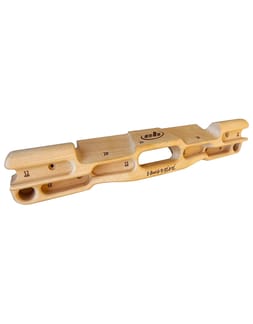

La Baguette
Climbing beam -






Travelboard
Climbing beam -





A climbing hangboard, also known as a fingerboard or training board, is equipment designed to develop finger strength and grip power. Used by both bouldering and sport climbers, it enables progress through targeted hanging exercises. Discover on Snowleader a selection of hangboards and climbing training equipment suitable for every level, from beginners discovering fingerboard training to advanced climbers seeking challenging edges.
Climbing training equipment: hangboards, boards and training gear
Climbing training equipment includes all gear dedicated to climbers' training: hangboards, training boards, fingerboards and suspension accessories. These tools allow you to specifically work on finger strength, endurance and coordination, whether you train at home or in a dedicated gym space. The hangboard remains the most popular and versatile piece of equipment for structuring regular progression.
Why choose a climbing hangboard for your training?
On rock or in the bouldering gym, progress often stalls at a strength plateau that climbing sessions alone can't overcome. The hangboard directly addresses this challenge: it isolates finger, forearm and suspension chain muscle work, helping you build grip strength in a targeted and measurable way. Unlike a gym session where you climb routes as a whole, each hang on a board can be timed, measured and gradually increased in difficulty, making it a particularly effective tool for structured progression.
Another key advantage: the hangboard can be installed at home, above a door or on a wall, allowing you to train daily without relying on gym opening hours. A few minutes of regular hangs are often more effective than a long, infrequent session, making the hangboard a valuable part of any training routine. Complete your setup with a chalk bag to keep your hands dry and optimise your grip throughout your session.
How to integrate a hangboard into your training routine
If you're new to hangboarding, two to three sessions per week are more than enough. Start with two-handed hangs on large holds, holding for five to ten seconds, then release and recover. Warming up is a step many climbers wrongly neglect: spend at least ten minutes mobilising your fingers, wrists and shoulders before loading your first hangs.
As the weeks go by, you can vary grip types to target all the muscles in your hand: open hand, crimp, half crimp, each working different muscle groups. Alternating these positions with bouldering sessions in the gym lets you apply the strength gains from the hangboard in a more dynamic climbing context. If you climb outdoors, a crash pad is essential for safe landings.
How to choose a climbing hangboard?
The choice of hangboard depends mainly on your climbing level and the grip types you want to train. Here are the main guidelines according to your profile:
- Beginner level: choose a board with large holds, deep jugs and generous rounded edges. The Move Board by EB or La Baguette by YY Vertical offer accessible profiles in a compact format.
- Intermediate level: opt for a model with medium edges (15 to 20 mm) in addition to jugs, to work finger strength without overloading the tendons. The Verticalboard One by YY Vertical offers this progressive setup.
- Advanced level: technical boards with small edges (6 to 15 mm), two-finger pockets, monos and sloping holds are essential. The Verticalboard Evo by YY Vertical provides this variety of grips, with the option to add Magnetics Inserts to customise the difficulty.
When starting hangboard training, the mistake is to choose a model that's too technical and risk injuring your finger tendons before making progress. Favour a board with deep jugs and rounded holds that protect your joints while building a solid strength base. Key criteria to check:
- Jugs and rounded holds offering enough comfort for prolonged hangs
- Compact dimensions, suitable for a door frame or narrow wall
- Durable material such as wood or resin, providing natural grip without being too abrasive on the skin
- A maximum supported load of at least 150 kg to ensure safety during dynamic exercises
Once you're climbing 7a routes or 6c boulders, the large holds of a beginner board no longer sufficiently challenge your fingers. Technical models offer a whole new range of grips: 6 to 15 mm edges, two-finger pockets, monos, slopers and pinches. Each of these targets a specific aspect of finger strength and lets you simulate the holds found on rock or in competition.
Some high-end boards go even further with modular designs: you can reposition or replace holds as you progress to adjust the difficulty without changing board. This modularity makes it a long-term investment, able to support your development over several training seasons.
How to properly install your climbing hangboard
Which materials to choose for durability?
The choice of material directly affects the feel, grip and longevity of your board. Wood remains the most popular: it offers a warm surface under the fingers, grip that improves slightly with use and proven strength. Polyester resin, found on many technical models, allows for very small edges and complex shapes impossible to achieve in wood. Moulded plastic is mainly used for entry-level boards and is suitable for discovering training without a major investment.
What size board to choose for your available space?
The length of a climbing hangboard generally ranges from 50 to 70 cm. Before buying, measure your available space and check that you can hang with arms fully extended without touching the floor: enough vertical clearance is essential for proper training. If your home doesn't allow for classic wall mounting, compact models designed for door frames are a good alternative. For those with a dedicated training wall, a wider board multiplies grip configurations and exercise possibilities.
How to safely mount a climbing hangboard at home?
Mounting determines the safety of every session. Wall mounting with anchors suitable for the surface (concrete, solid brick, breeze block) is the most reliable solution: use at least four anchor points and strictly follow the manufacturer's instructions. Plasterboard walls should be avoided, as they can't support the dynamic loads generated by hanging exercises. Alternatively, some boards can be mounted on a freestanding pull-up bar or directly onto a structural beam, avoiding drilling walls while ensuring sufficient stability.
Accessories to complete your hangboard training
A hangboard alone already covers a wide range of exercises, but a few well-chosen accessories can take your training further. Resistance bands like EB's E-Lastic reduce bodyweight and make the board accessible to climbers in rehab or just starting out. Conversely, a weighted vest or belt adds resistance for advanced users looking to push their maximum strength. For warming up, EB's Xpress handles or the Black Diamond Forearm Trainer effectively prepare your forearms before each session.
Because good training also starts with good footwork, make sure to choose climbing shoes suited to your needs. Explore all our climbing accessories on Snowleader to create your ideal training space.
FAQ about climbing hangboards
What's the difference between a hangboard and a fingerboard?
None: both terms refer to the same equipment. “Climbing hangboard” is the most common term in French, while “hangboard” comes from English and is widely used in the climbing community. You may also see “training board” or “fingerboard”, all referring to the same type of equipment. Whatever the name, it's a board with various holds, fixed at height, on which you hang to train finger strength.
Where to install a climbing hangboard at home?
The ideal location is a load-bearing wall made of concrete or solid brick, in a room with enough height to hang with arms fully extended without touching the floor. A solid door frame can also work for compact models designed for this purpose. Avoid plasterboard walls, false ceilings and damp walls. If you don't want to drill, a freestanding support is a reliable and stable alternative.
Which climbing hangboard to choose for your level?
The choice mainly depends on your climbing experience. If you've been climbing for less than a year or climb below 6a, choose a board with large holds and deep jugs. Above 6c-7a, a technical model with small edges and varied configurations will provide the stimulation needed to keep progressing. If you're unsure between two levels, a versatile board with several hold sizes is the best compromise for evolving without changing equipment.
How to maintain your climbing hangboard?
Maintenance depends on the material. For a wooden board, regularly brush the surface with a stiff brush to remove chalk and sweat deposits that eventually smooth the grain. When grip noticeably decreases, a light sanding with fine sandpaper (120 to 180 grit) restores texture without damaging the holds. For resin boards, simple cleaning with warm water and a brush is enough. In all cases, periodically check the tightness of wall fixings, especially after the first weeks of use.
Can you customise your climbing hangboard for tailored training?
Several manufacturers now offer modular systems where holds can be screwed and unscrewed to reconfigure the board as you progress. You can replace a jug that's become too easy with a smaller edge, or add a mono to target a specific weakness. This modular approach turns your board into a true evolving training station, able to adapt to your goals season after season.
Snowleader offers a wide range of climbing hangboards and training accessories with free delivery from €199 and free returns within 60 days.


Our Bloch' letter


