


 Menu
Menu


Nordic Walking Poles




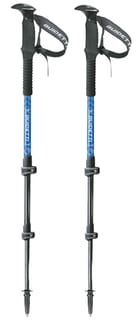


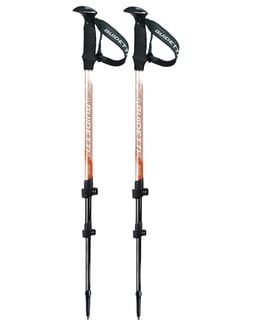



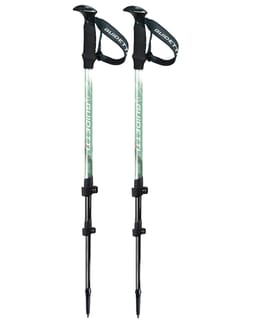


A complete and accessible activity, Nordic walking appeals to both fitness enthusiasts seeking a cardio workout and nature lovers wanting to protect their joints. The right equipment is essential: the choice of pole directly affects comfort and performance. Snowleader helps you choose with a range designed for every user.
Why choose Nordic walking poles?
Contrary to popular belief, Nordic walking poles are not just for balance-they are the driving force behind the activity. Their specific design, very different from trekking poles, enables a backward push that propels you forward and engages your entire muscle chain. This movement, inspired by cross-country skiing, transforms a simple walk into a full-body workout.
The benefits of Nordic walking
Practised regularly, Nordic walking offers benefits few endurance activities can match. Among the advantages of Nordic walking poles are:
- engagement of around 80% of the body's muscles, upper and lower.
- 20-40% higher energy expenditure compared to regular walking.
- effective cardio-respiratory workout without traumatic impact.
- improved overall posture thanks to an upright torso.
- significantly reduced strain on knees and ankles.
Key features of Nordic walking poles
Modern poles, mostly made from carbon or aluminium, absorb shocks and filter vibrations, protecting the joints in your wrists, elbows, shoulders, and neck. Beyond the material, a quality Nordic walking pole features a dedicated strap, acting as a true power transfer between your hand and the pole during the push phase, and a tungsten carbide tip for secure grip on paths and trails.
How to choose your Nordic walking poles
Choosing the right pair of poles means considering several factors, whether you walk weekly for leisure or train more intensively. At Snowleader, you'll find a carefully selected range from Leki, TSL Outdoor and Guidetti, covering all price points and experience levels.
The ideal pole length
Pole length is one of the most important factors. If your poles are too short or too long, your walking posture will suffer, potentially causing back pain. The rule is simple: when holding the pole upright, your arm should form a right angle.
If ordering online and unable to test the length, use this proven formula: multiply your height in centimetres by 0.68. For example, someone 1.70 m tall should choose a pole around 115 cm, while someone 1.80 m tall should opt for about 122 cm.
We recommend adjustable poles for children whose height changes quickly, if the poles will have multiple users, if you plan to lend them, or for frequent travellers seeking minimal bulk. Two- or three-section telescopic models fit easily in a bag and offer a good balance between strength and compactness.
Materials: aluminium vs carbon
Two main materials dominate the market, each with its own advantages. Aluminium is valued for its unbeatable durability and price, making it ideal for occasional users or beginners. Carbon, though more expensive, is the choice for performance: its lightness reduces fatigue on long walks, and its vibration absorption protects your joints. Some models combine both, with a carbon upper section for feel and an aluminium lower section for impact resistance.
Handles and straps: comfort and grip
Handle choice is mainly between cork and plastic. Both offer a good grip, but cork is preferred by regular users as it moulds to the hand over time, naturally absorbs sweat, and stays comfortable in both summer and cool mornings.
The strap deserves special attention, as it transfers arm power to the pole during the push, then releases the hand at the back without restricting movement. A good, enveloping strap should fit perfectly-not too tight or loose-and ideally feature a quick-release system so you can detach the pole in a second to drink, eat, or check a map.
Tips for different terrains
Straight tips are best for soft ground, while angled tips suit firmer surfaces. On tarmac, hard-packed paths or limestone, bare tips can be uncomfortable and noisy: simply fit a rubber cap, sometimes called a "pad", which clips on in seconds. These Nordic walking pole accessories are inexpensive, extend tip life, and provide reassuring grip on hard surfaces.
The best Nordic walking pole brands
Snowleader brings together the most recognised manufacturers in the discipline, with a strong focus on French expertise. From German innovation to French craftsmanship, you'll find the right model for your needs and style.
Leki: innovation and quality
The German brand Leki is a pioneer in the field, equipping both casual walkers and international competitors. Its patented Trigger Shark system, allowing you to clip and unclip the strap in a split second, remains a benchmark across the sector. To explore the full range and discover quality Leki poles, visit our dedicated selection.
TSL Outdoor: durability and versatility
Based in the French Alps, TSL Outdoor has built its reputation on products designed to last and adapt to multiple uses. The Tactil C100 Cork Spike Cross, designed specifically for Nordic walking, perfectly illustrates this philosophy with its carbon shaft, cork handle, and ergonomic strap. The Hiking and Country ranges complete the offer for those who want to alternate between Nordic walking and hiking.
Guidetti: French tradition and expertise
Based in Haute-Savoie, Guidetti continues a tradition of craftsmanship with a complete range of poles named after France's great mountain ranges, from Mont Blanc to the Vosges, Corsica, and the Massif Central. The brand focuses on robust, reliable, and accessible products, designed for regular use and able to withstand the tough conditions of forests and technical trails.
Les Bâtons d'Alain: French craftsmanship
Handmade in the Jura with meticulous care, Les Bâtons d'Alain represent a truly artisanal approach, with models named Azur, Cerise, Pomme, Framboise, Panthère and a distinctive visual identity that appeals to walkers seeking both performance and uniqueness. This French brand upholds a traditional expertise now rare in the pole market.
FAQ: your questions about Nordic walking poles
How do you care for and clean Nordic walking poles?
After each walk, a simple dry cloth is enough to remove mud and moisture from the sections. For telescopic models, regularly separate the sections to let the inside dry: residual moisture can cause the locking mechanisms to oxidise and gradually seize up. Brush the carbide tip, check the rubber caps, and visually inspect the straps-this simple routine will significantly extend the life of your equipment.
Can you use Nordic walking poles for hiking?
While both activities involve walking, the poles are designed differently. Nordic walking poles are made for propulsion, with an open strap at the back to release the hand with each push. Trekking poles, on the other hand, focus on support and shock absorption on descents, with a closed wrist strap and sometimes an anti-shock system. For occasional mixed use, some versatile models bridge the gap, but for regular practice, it's best to have dedicated equipment for each activity.


Our Bloch' letter


