


 Metropolitan France
 United Kingdom
 Deutschland
 Belgique
 Suisse
 Österreich
 España
 Italia
 Danmark
 Sverige
 Portugal
 Polska
 Luxembourg
 Other countries

1. Ski


Superwolf 2026
Hiking skis - Unisex -
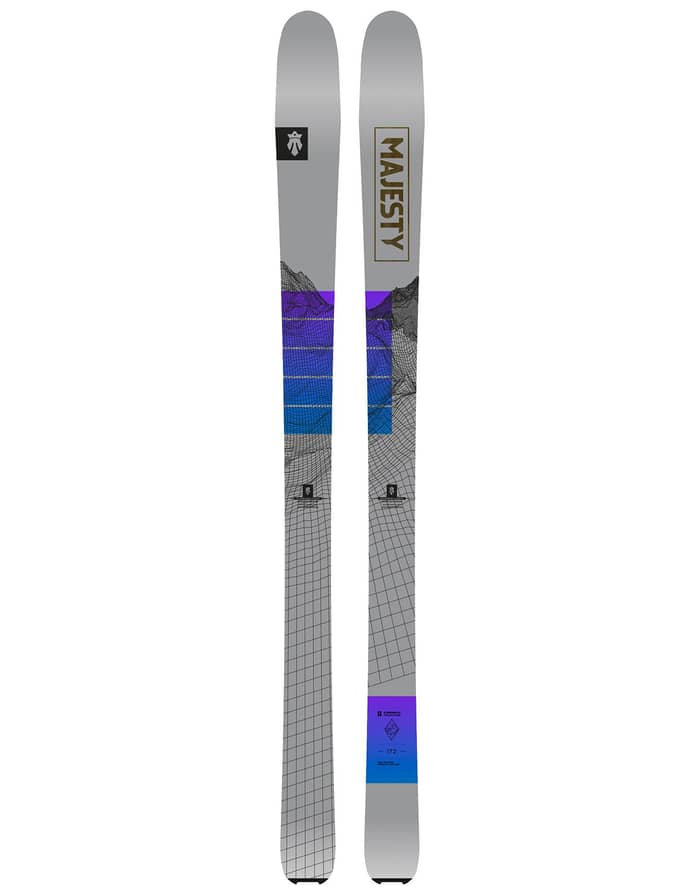
The Superwolf 2026 is a unisex ski touring ski from Majesty.
The Superwolf is at the heart of East's Hiking range. Majesty. More Versatile than its younger sibling, it's the perfect ski for pushing adventure a little further.
With a slightly wider stance and a more generous rocker, it adapts well to a range of conditions, from deep snow to steep couloirs. At around 1400g per ski (172cm), it's still very light, so you don't have to exert yourself when you're climbing.
Construction levels include a new paulownia core reinforced with poplar grooves. Its fairly rigid flex, combined with a directional shape and a slightly rockered tail, gives it stability at high speeds and excellent handling when skiing more complicated, changing snow conditions. You'll also notice its handling in narrow passages.
The Superwolf will be the ideal ski for your Hiking or Ski mountaineering outings. Its Lightness will help it to cope with the drops without any worries, while retaining its excellent qualities on the descent.


| SIZE (cm) | SIDECUTS (mm) | RADIUS (m) | SKI WEIGHT (g) |
| 148 | 126-89-107 | 13 | 1110 |
| 154 | 127-91-107 | 14 | 1180 |
| 160 | 128-91-108 | 15 | 1280 |
| 166 | 129-91-109 | 16 | 1360 |
| 172 | 130-91-110 | 17 | 1430 |
| 176 | 131-91-111 | 18 | 1520 |
| 184 | 132-91-112 | 19 | 1600 |
| CORE | Paulownia wood for lightness and responsiveness. |
| CUT-OFF-TAIL | A shorter tail length and a backwards skier position for faster, more versatile skis. |
| FAST BASE | The bases are made from P-Tex (polyethylene plastic). Most basic materials are followed by a number. This number refers to the molecular weight of polyethylene. The higher the number, the higher the molecular weight of P-Tex, indicating a better, more durable base. Majesty uses a high-quality IS 7200 base. |
| TEXTOLITE PLATE |
Sheet of reinforcement material (epoxy-impregnated fibreglass fabric) superimposed over the Core to support the central part of the ski. |
| FRONT ROCKER |
The rocker is the curve of the front or rear part of the ski when viewed from the side. In other words, the rocker refers to the arched section of the ski from the point of contact with the surface to the tip or rear end. Depending on the length and shape of the rocker, it can be called an automatic rocker, a flat camber rocker or an elliptical rocker. The rocker makes it easier to pirouette in Powder snow and gives you a feeling of freedom and forgiveness. It improves floatation and makes all-terrain handling effortless. |
| MOUNTING SKINS | The heels of the skis are fitted with specially designed holes to allow precise positioning of the skins and reduce the possibility of the rear clip slipping during ascent. |
| CAMBER | The camber describes the curve of a ski when viewed from the side. Skis with camber have a central section that arches slightly over the snow. Depending on the length and height of the camber, it can be distinguished as a traditional camber or a flat camber (zero camber). The Edge provides elasticity, suppleness, precision, responsiveness, good edge control and good ripping. |
Taillé pour pouvoir aller partout, le Superwolf est un ski polyvalent qui vous suivra dans toutes vos aventures. Avec un poids correct pour son gabarit il ne sera pas un poids sur les longues courses et offre de vraies qualités à la descente. Que vous soyez débutant ou bon skieur, vous saurez prendre du plaisir avec ce ski qui pourra vous suivre toute l'année. De la neige dure à la poudreuse en passant par la neige printanière c'est un vrai plaisir à skier.
Un ski de rando pour les gourmands d'aventures.
Les plus : Polyvalence en toutes neiges.
Les moins : Accroche réduite sur neige plus dure.



Sign up for our newsletter
Be the first to hear about promotions, sales, special offers, snowleader events, and new brands added to our catalog!
By signing up for our newsletter, you agree to receive our personalized emails and to allow us to track whether you open them. You can change your consent at any time after you first receive a communication, or after creating your account, if applicable.


